



 Global
 Belgium
 Denmark
 Finland
 Germany
 Malaysia
 Netherlands
 Norway
 Poland
 Sweden
 UK
UK
WHY ACTIVE DIRECTORY SECURITY MATTERS
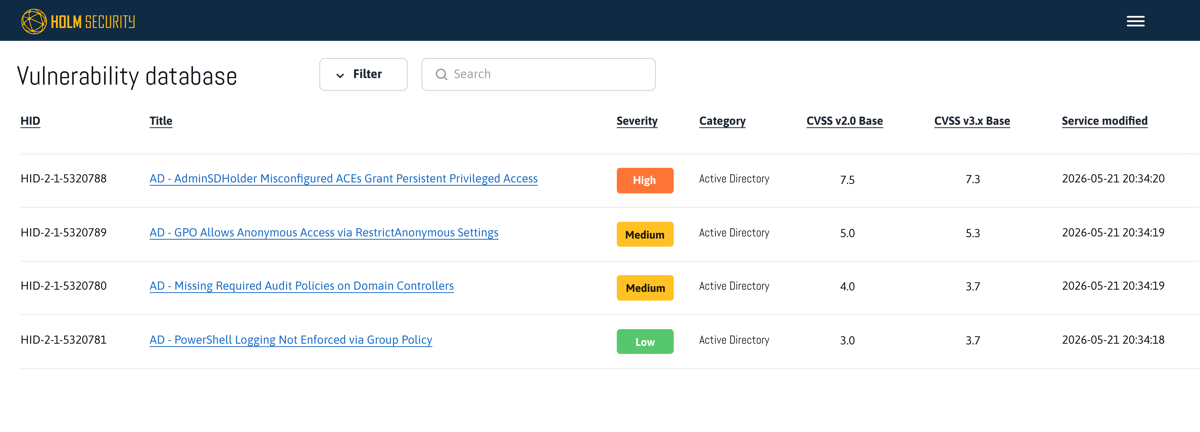
Reduce your Active Directory attack surface
- Harden your on-premises identity foundation before attackers try to exploit it.
- Replace manual scripts, quarterly reviews, and standalone point-in-time tools with continuous, scheduled assessments inside the platform you already use.
- Build a systematic, repeatable cybersecurity approach as required by NIS2 and DORA.
- Prove your Active Directory baseline holds over time, with severity-based prioritization, ignore rules, ticketing integrations, and reporting built in.
- Extend your coverage into surfaces the CIS Benchmark does not yet reach, including certificate services, Kerberos delegation, and privileged access management.
"Holm Security has become an integral part of our cyber security strategy, helping us protect client data, meet compliance requirements, and maintain operational resilience."

"Since implementing Holm Security's Next-Gen Vulnerability Management Platform, we continuously monitor vulnerabilities and know where we are vulnerable."


"The data and visibility we've received from Holm Security's platform have allowed us to set up regular scanning of our OT environment, reduce our risk score, and remove vulnerabilities - from software and hardware alike. I'm very happy with the progress we've made, and our CSM is always on hand when needed."


"Holm Security's Customer Success and Support & Delivery teams have been instrumental in helping us interpret and act on the extensive data gathered from our IT environment scans. Their guidance has enabled us to transform raw scan results into meaningful insights, giving us a clear, comprehensive overview of our infrastructure. We can now effectively prioritize our assets and vulnerabilities based on business relevance, significantly improving our ability to manage risk and maintain a stronger security posture."


"With Holm Security, we identify vulnerabilities as they emerge in our environment and gain deep insight into their severity, exploitability, and business impact. The platform delivers clear and actionable remediation guidance, enabling us to prioritize risks correctly and address them efficiently."


"Both the platform and the support have worked well from the start. From network and web application scanning to Customer Success, Holm Security delivers what we need."