


 Belgium
 Denmark
 Finland
 Germany
 Malaysia
 Netherlands
 Norway
 Poland
 Sweden
 UK
UK


Operational Technology (OT) runs the physical world. The systems that keep water flowing, power on the grid, and production lines moving were built for uptime and safety, not for today's threat landscape. In 2026, the gap between how these systems were designed and how they are being attacked has become one of the most pressing problems in cybersecurity.
Most organizations still assess their IT far more thoroughly than their OT. In fact, many barely assess their OT at all.
Do you even have OT? (probably)
OT is easy to dismiss as a problem for factories and power plants. It is not. OT is any technology that monitors or controls physical equipment, and most organizations have more of it than they realize.
If you run a manufacturing line, a utility, or a logistics operation, the OT is obvious: PLCs, RTUs, SCADA systems, and industrial sensors. But ordinary companies that would never call themselves “industrial” run OT every day:
- Building management systems that control HVAC, lighting, and energy. Most commercial buildings built after 2000 have one.
- Physical access control such as badge readers, turnstiles, door controllers, and elevators.
- Surveillance and safety systems including CCTV, fire alarms, and intrusion detection.
- Backup power and environmental controls such as UPS units and data center cooling.
These devices sit on your network, often unmanaged and rarely patched, and they are exactly the kind of exposed system attackers now look for. If your building has a badge reader and a thermostat you cannot see in your security tooling, you have an OT blind spot.
The 2026 picture: More attacks, more exposure, less visibility
This year's data makes the trend hard to ignore.
- Disclosures are climbing fast. Researchers logged 2,451 ICS vulnerability disclosures across 152 vendors in 2025, nearly double the 1,690 a year earlier.
- The detection gap is real. In a 2025 industrial benchmark, 44% of organizations claimed strong real-time cyber visibility, yet nearly 60% had low to no confidence in their ability to detect OT and IoT threats, and a third took more than 90 days to remediate the threats they did find.
- Regulation has caught up. NIS2 requires asset inventory, vulnerability management, and access control across OT, with personal liability for leadership.
The attack surface is growing, the threats are more capable, and the rules now require you to prove you have a handle on it.
Why OT is harder to secure than IT
OT is not just IT with a different label. The devices are often old, sensitive, and intolerant of the aggressive scanning that standard IT tools use without a second thought. A PLC was never designed to absorb heavy network traffic.
That creates a trap. The tools that would give you visibility feel too risky to run, so the environment goes unassessed, so the exposure grows. Breaking that cycle is the real challenge of OT security in 2026.
How Holm Security solves it
The Holm Security Platform closes the OT blind spot by extending the same exposure and vulnerability management you already use across IT, network, cloud, and identity into your industrial environment. One platform, one view of risk, instead of a separate tool bolted on the side.
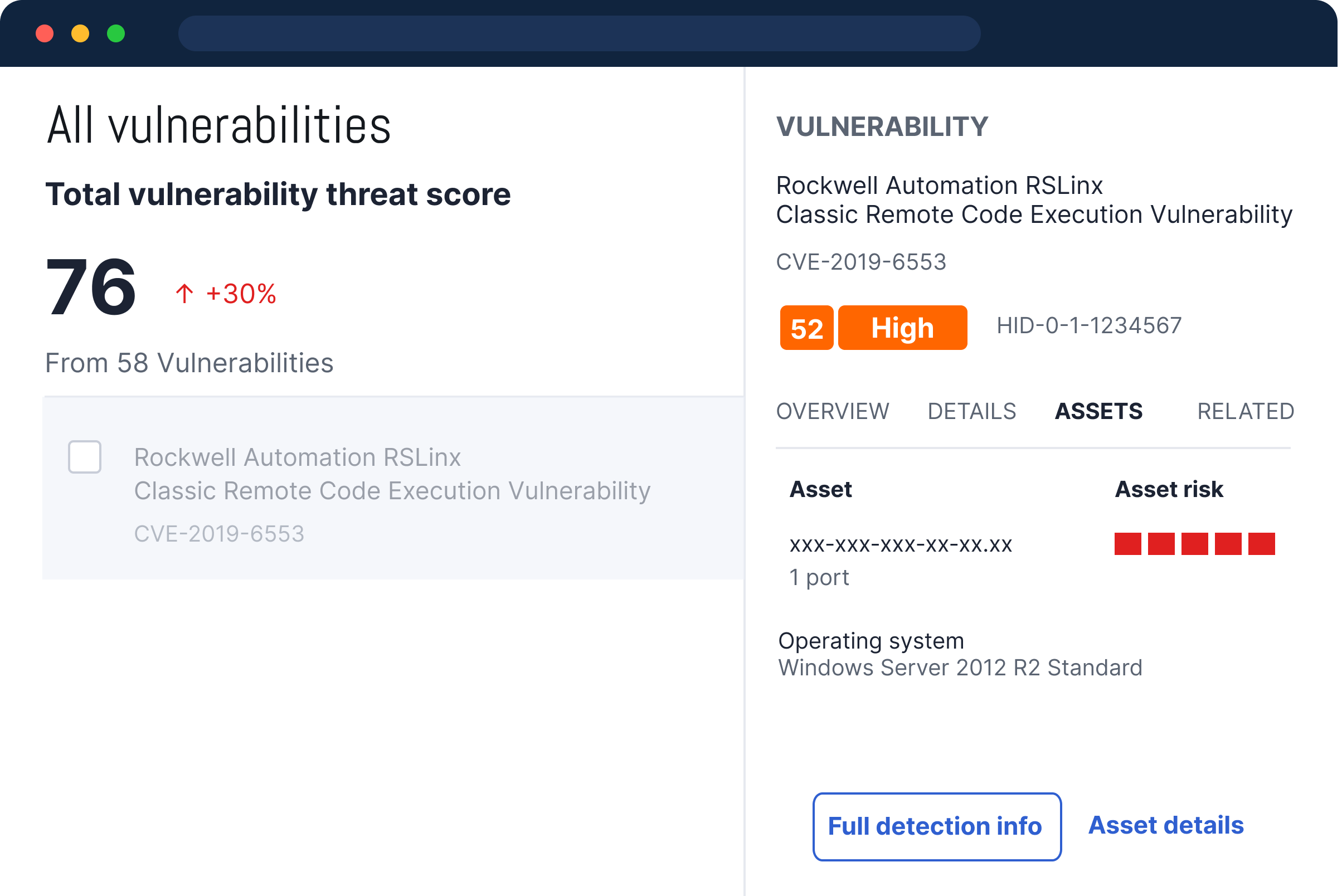
Find vulnerabilities across your OT environment and IoT devices, with a total threat score and granular detection details.
Four things make that safe and practical:
- Assessment on your terms. You set scope, schedule, and intensity. Limit assessments to specific IP ranges, run them inside maintenance windows, cap packet rates, and exclude fragile assets. Nothing runs without your configuration.
- Honest, low-impact defaults. Our default profiles run read-only checks, stay inside your configuration, and never reach for aggressive techniques. A separate Aggressive profile exists for controlled, pre-production testing when you choose it. No vendor can promise zero risk, and we will not pretend otherwise. What we guarantee is how our defaults behave.
- The right method per device. A lightweight Device Agent covers Windows assets with no network probing at all, the safest option for sensitive hosts. Network-connected control devices are assessed through tuned, low-impact profiles with deep awareness of industrial protocols, so we can safely reach systems that IT-focused scanners cannot.
- Coverage that keeps pace. Trained AI models triage new disclosures and generate detection tests nightly, all quality-assured before release. When something cannot be handled automatically, a team focused only on SCADA and OT handles manual analysis and validation.
As a European company, we also keep your sensitive data in Europe, which matters especially for operators in regulated and critical sectors. The goal is not another point tool. It is to close the OT gap using the discipline you already trust everywhere else. See how Holm Security covers OT and SCADA.
Start with visibility
Wherever you are, the first step is the same: know what you have. An accurate picture of your OT assets and their exposure turns invisible risk into managed risk, and it is the foundation every framework, from NIS2 to IEC 62443, is built on.
If your OT is going largely unassessed today, 2026 is a good year to change that.

FAQ
-
What is OT security, and how is it different from IT security?
OT (Operational Technology) security protects the systems that monitor and control physical equipment - from PLCs and SCADA systems to building management, access control, and surveillance. It differs from IT security because OT devices are often older, more sensitive, and intolerant of the aggressive scanning standard IT tools rely on, making visibility harder to achieve safely.
-
Does my organization have OT if we're not industrial?
Almost certainly. OT isn't limited to factories and utilities. If your building has HVAC controls, badge readers, CCTV, fire alarms, elevators, or UPS units, you're running OT - often unmanaged and rarely patched.
-
Why is OT harder to assess than IT?
Many OT devices weren't built to absorb heavy network traffic. The tools that would provide visibility can feel too risky to run, so environments go unassessed and exposure grows. Breaking that cycle requires methods designed specifically for sensitive industrial assets.
-
How does Holm Security assess OT without disrupting operations?
You control scope, schedule, and intensity - limiting assessments to specific IP ranges, running them inside maintenance windows, capping packet rates, and excluding fragile assets. Default profiles run read-only, low-impact checks, and a lightweight Device Agent covers Windows assets with no network probing at all.
-
Does OT security help with NIS2 compliance?
Yes. NIS2 requires asset inventory, vulnerability management, and access control across OT, with personal liability for leadership. An accurate picture of your OT exposure is the foundation every framework - from NIS2 to IEC 62443 - is built on.
-
Where is my OT data stored?
As a European company, Holm Security keeps your sensitive data in Europe, which matters especially for operators in regulated and critical sectors.