


 Belgium
 Denmark
 Finland
 Germany
 Malaysia
 Netherlands
 Norway
 Poland
 Sweden
 UK
UK


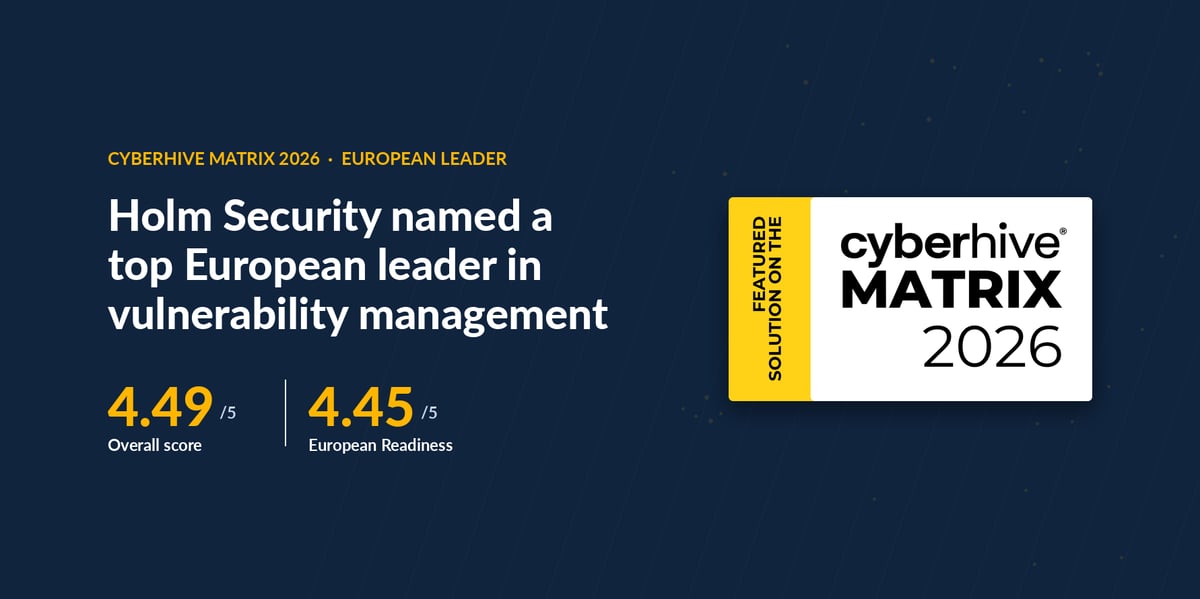
Holm Security has been placed among the European leaders in the Vulnerability Management category of the Cyberhive Matrix 2026, the independent evaluation of European cybersecurity solutions run by Cyberhive in partnership with the European Cyber Security Organisation (ECSO), released to mark ECSO’s 10th anniversary.
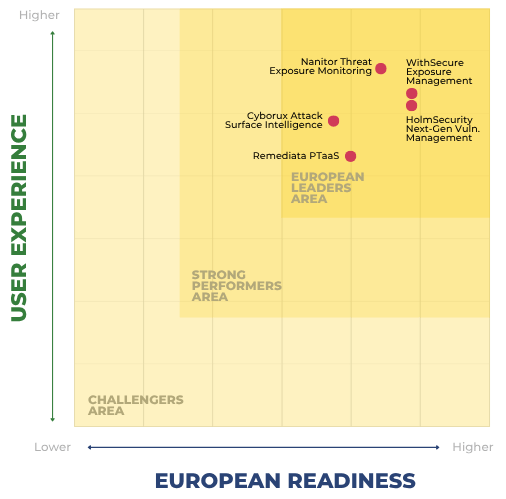
The Holm Security Next-Gen Vulnerability Management Platform earned a strong overall score of 4.49 on a 5-point scale, assessed against four other European vendors in the category. The figure we’re proudest of, though, is our European Readiness rating of 4.45. It’s the measure that matters most for European organizations right now.
The Matrix is built on the new ECSO Cybersecurity Taxonomy. It plots each solution on two axes: user satisfaction and European Readiness. Solutions that score high on both land in what the report calls the European Leaders Area. This builds directly on the two European digital sovereignty labels we received earlier this year.
Why European Readiness matters more
On June 3, 2026, the European Commission unveiled its European Technological Sovereignty Package, its most ambitious effort yet to reduce reliance on non-European cloud, software, and infrastructure.
The EU currently depends on non-EU providers for over 80% of its key digital products, services, and infrastructure. The Commission no longer frames this as a market inefficiency to tolerate. It treats it as a strategic vulnerability to be corrected through legislation.
That shift is already reaching procurement. Brussels has proposed barring cloud providers that fail to meet new sovereignty criteria from sensitive government contracts. Where a solution is built, owned, and hosted is moving from a talking point to a buying condition.
Regulation is making cyber risk management mandatory
Sovereignty is arriving alongside a broader regulatory tightening that has turned security into a compulsory line item rather than a discretionary one.
- NIS2 now covers more than 160,000 European entities, with penalties of up to EUR 10 million or 2% of global turnover.
- DORA imposes parallel ICT risk mandates on financial entities, pushing them to restructure vendor portfolios for resilience.
- The EU Cyber Resilience Act starts to apply from September 11, 2026, adding mandatory reporting of actively exploited vulnerabilities.
Vulnerability and exposure management sits at the center of nearly every one of these mandates. You can’t prove you manage risk without first being able to see it, and as sovereignty moves from preference to requirement, European buyers increasingly want a platform built and operated in Europe - not just sold there.
The takeaway for security leaders
The direction of travel is clear. Regulation is making cyber risk management non-negotiable, and sovereignty is becoming part of the compliance and procurement conversation rather than a marketing flourish. The organizations that get ahead of this will treat “where does my data live” as a first-order question, not an afterthought.
The encouraging part is that European buyers no longer have to choose between capability and sovereignty. You can get leading exposure and vulnerability management without sending sensitive data outside Europe.
See how our exposure and vulnerability management platform helps European organizations build a systematic, risk-based, and proactive cyber defense.
The complete Cyberhive Matrix 2026, including methodology, vendor profiles, and the full Vulnerability Management quadrant, is available to download from Cyberhive.